Ask three One Piece fans to rank the Devil Fruit types by power and you will get three different answers — usually delivered at high volume. Logia users can turn into lightning, so surely they are the strongest. But wait, Kaido is a Zoan and he was called the strongest creature alive. And yet the current King of the Pirates, the man who ate what everyone thought was a simple rubber Paramecia, out-punched them all.
The truth is that the three-type system — Paramecia, Zoan, and Logia — is less a power ranking and more a taxonomy, and understanding it properly changes how you watch the series, how you argue about it online, and (if you play our Devil Fruit guessing game) how quickly you crack each day's puzzle.
This guide covers all three types in depth, then goes somewhere no other Devil Fruit explainer goes: original data. We maintain a curated database of the 150 most important One Piece characters for Animedle, each tagged with their exact fruit and type. That dataset reveals some genuinely surprising patterns — including the fact that Mythical Zoans, supposedly the rarest fruits in the world, outnumber Logias among the top cast.
Here is what you will learn:
- What Devil Fruits are and the rules every fruit follows
- Clear, spoiler-light definitions of Paramecia, Zoan, and Logia
- A side-by-side comparison table of all three types
- Original statistics: the fruit-type breakdown across 150 key characters
- How to use all of this to win the Devil Fruit dle mode
What Is a Devil Fruit?
A Devil Fruit is a mysterious, swirl-patterned fruit in One Piece that grants its eater a supernatural ability at a permanent cost: the sea itself rejects them. Every fruit user loses the ability to swim, and submersion in standing water (or contact with Seastone) drains their strength. Each fruit exists as a single specimen in the world — when a user dies, the fruit reincarnates into a nearby fruit of similar appearance — so no two living people can hold the same power. All Devil Fruits fall into one of three categories: Paramecia (superhuman abilities), Zoan (animal transformation), and Logia (elemental embodiment).
Beyond that shared rulebook, a few more universals are worth knowing before we compare the types:
- One fruit per person. Eating a second fruit is said to make the eater's body explode. Only one known character has ever broken this rule, and how he did it remains one of the series' open mysteries.
- The first bite is enough. The whole fruit does not need to be eaten, and it reportedly tastes horrible regardless of type.
- Awakening exists for all three types. A sufficiently experienced user can "awaken" their fruit, pushing its effects beyond their own body. We cover this in its own section below, because awakening works differently for each type.
With the ground rules set, let's take the three types one at a time.
What Is a Paramecia?
A Paramecia is any Devil Fruit that grants a "superhuman" ability without turning the user into an animal or a natural element. It is the broadest and most common of the three Devil Fruit types, covering everything from body alteration (splitting into pieces, sprouting limbs) to environmental manipulation (creating barriers, controlling gravity) to abilities that border on reality editing. Because the category is defined by what it is not, Paramecia powers vary wildly in strength — the type contains both the silliest fruits in One Piece and several of the most feared.
The best way to grasp the range of Paramecia is through examples:
- Nico Robin's Hana Hana no Mi (Flower-Flower Fruit) lets her sprout copies of her own body parts on any surface — arms blooming from an enemy's shoulders to restrain them, an ear on a wall to eavesdrop. A "simple" body-alteration fruit that becomes terrifying with creativity.
- Trafalgar Law's Ope Ope no Mi (Op-Op Fruit) creates a spherical "Room" inside which Law can cut, swap, and rearrange anything — organs, personalities, positions in space — without killing anyone. It was called the "Ultimate Devil Fruit" and is a textbook case of a Paramecia whose ceiling is far above most Logias.
- Whitebeard's Gura Gura no Mi (Tremor-Tremor Fruit) generates quakes capable of tilting the sea and shattering the sky. It was widely described as the strongest Paramecia and held the power to destroy the world.
And then there is the most famous "Paramecia" of all: for over twenty years, Monkey D. Luffy's rubber powers were attributed to the Gomu Gomu no Mi, a run-of-the-mill body-alteration Paramecia. The Wano arc revealed the truth — his fruit is actually the Hito Hito no Mi, Model: Nika, a Mythical Zoan whose true nature was hidden even from its user. It is the single greatest fruit-classification twist in the series, and a good reminder that in One Piece, the label on the tin is not always the truth.
What Is a Zoan?
A Zoan is a Devil Fruit that lets its user transform into a specific animal, as well as a human-animal hybrid form that combines both. Zoan fruits physically strengthen the eater — boosting durability, recovery, and raw physical stats in ways the other types do not — which makes them the type most favored by close-combat fighters. Uniquely among Devil Fruits, Zoans are said to carry a will of their own, and they split into three subtypes of escalating rarity: regular Zoan (living animals), Ancient Zoan (extinct species like dinosaurs), and Mythical Zoan (legendary creatures), the rarest classification of any fruit in the series.
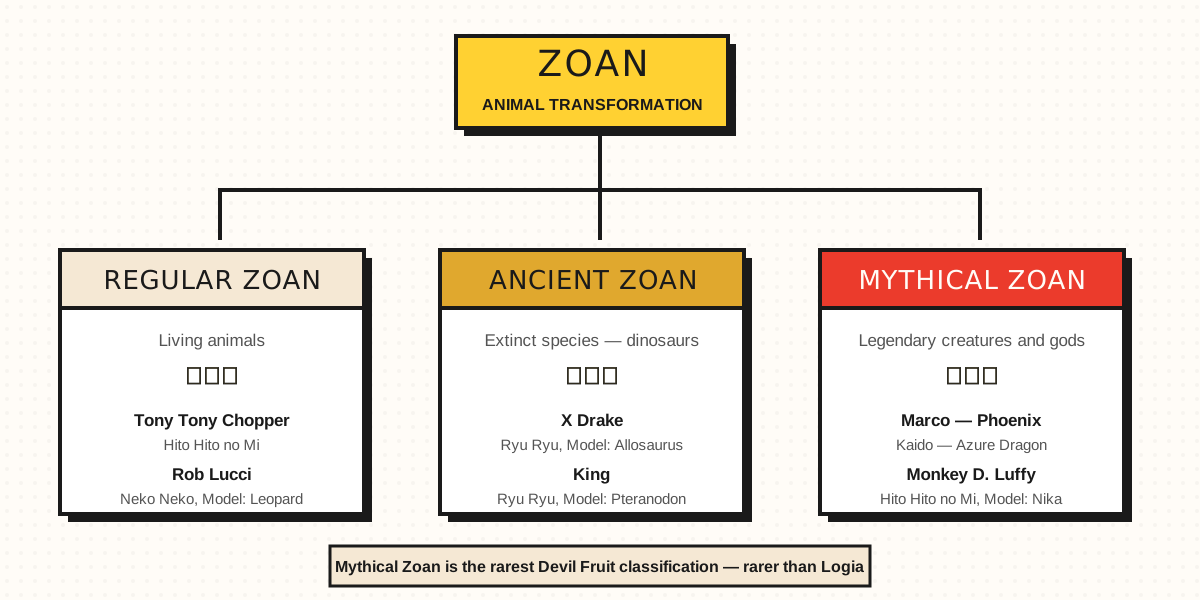
The three Zoan subtypes, from common to "rarer than Logia."
Regular Zoan
The baseline: transformation into an ordinary living animal. Tony Tony Chopper's Hito Hito no Mi (Human-Human Fruit) is the fandom's favorite example — eaten by a reindeer, it granted him human intelligence and a human form, effectively working in reverse. CP9's Rob Lucci wields the Neko Neko no Mi, Model: Leopard, proof that even a "common" Zoan in the hands of a master martial artist is nightmare fuel. His colleague Kaku turned into a giraffe and was still one of the deadliest assassins in the World Government.
Ancient Zoan
Transformation into extinct species — overwhelmingly dinosaurs. Ancient Zoans grant a further durability and power boost above regular Zoans, which is why Kaido stacked his Beasts Pirates headliners with them: King (Pteranodon), Queen (Brachiosaurus), Jack (Mammoth), and the Tobiroppo including X Drake (Allosaurus), Ulti (Pachycephalosaurus), and Page One (Spinosaurus). In our 150-character dataset, 8 characters carry Ancient Zoans — and 6 of the 8 debut in the same two arcs, a pattern worth remembering if you play the daily guessing game.
Mythical Zoan
Transformation into creatures of legend — dragons, phoenixes, deities. Mythical Zoans are explicitly described as the rarest Devil Fruits in existence, rarer even than Logia. They also tend to carry secondary powers beyond transformation: Marco's Tori Tori no Mi, Model: Phoenix grants regenerative blue flames; Kaido's Uo Uo no Mi, Model: Seiryu made him an Azure Dragon who commands elemental breath and weather; Sengoku's Hito Hito no Mi, Model: Daibutsu turns the former Fleet Admiral into a golden shockwave-emitting Buddha; and Yamato's Inu Inu no Mi, Model: Okuchi no Makami is a wolf deity with ice powers. And, as revealed in Wano, Luffy's Nika fruit sits at the very top of this category.
What Is a Logia?
A Logia is a Devil Fruit that lets its user create, control, and become an element of nature. It is traditionally called the rarest and most powerful of the three basic types, because Logia users gain a passive defense the others lack: elemental intangibility. Physical attacks pass harmlessly through a body made of fire, smoke, or lightning unless the attacker uses Haki, exploits the element's natural weakness (water grounds sand, for example), or hits with Seastone. For the first half of the series, an untouchable Logia body was close to a win condition all by itself.
The Logia roster reads like a list of One Piece's scariest arc villains and top brass:
- Portgas D. Ace ate the Mera Mera no Mi and became fire itself; after his death the fruit passed to his sworn brother Sabo.
- Sir Crocodile's Suna Suna no Mi turns him into sand and lets him drain the moisture from anything he touches — Luffy needed three attempts to solve him.
- Enel's Goro Goro no Mi (lightning) was so oppressive that only Luffy's rubber body — a natural insulator — could counter it. On any other opponent, Enel might still be ruling Skypiea.
- The Marine admirals are a Logia showcase: Sakazuki (magma), Kuzan (ice), Borsalino (light), and the newer admiral Aramaki (forests). Smoker (smoke) and Blackbeard's darkness round out the type's heavy hitters.
The catch — and it is a big one — is that the Logia advantage has aged. Once Haki became standard equipment for New World fighters, intangibility stopped being an auto-win, and the type's reputation as "the strongest" started to look more like early-series nostalgia. The data below makes that argument quantitatively.
Paramecia vs Zoan vs Logia: Side-by-Side
Here is the full comparison in one table:
| Dimension | Paramecia | Zoan | Logia |
|---|---|---|---|
| Core ability | Superhuman power (body, environment, or rule-bending) | Animal transformation + hybrid form | Become, create, and control a natural element |
| Rarity | Most common | Common; Mythical subtype is the rarest of all fruits | Traditionally called rarest of the three basic types |
| Combat style | Varies wildly — utility, control, artillery | Close combat, physical overwhelm | Area denial, elemental artillery |
| Physical boost | None inherent | Large — strength, durability, recovery | None inherent |
| Intangibility | No | No | Yes — bypassed by Haki, element counters, Seastone |
| Awakening effect | Power extends to surrounding environment | Greater strength and recovery; risk of losing self | Environment transmutation on a massive scale |
| Famous users | Whitebeard, Law, Robin, Doflamingo | Kaido, Marco, Lucci, Chopper, Luffy (Nika) | Ace, Crocodile, Enel, the admirals |
| Signature weakness | Ceiling depends entirely on the specific fruit | Predictable form; some subtypes are common | Haki made intangibility unreliable |
If you only remember one row, make it Physical boost. It explains the series' entire power geography: Zoans dominate frontline melee (Kaido's crew, CP9), Logias dominate ranged control (the admirals), and Paramecias fill every niche in between — including, at the extremes, the strongest fruits ever shown.
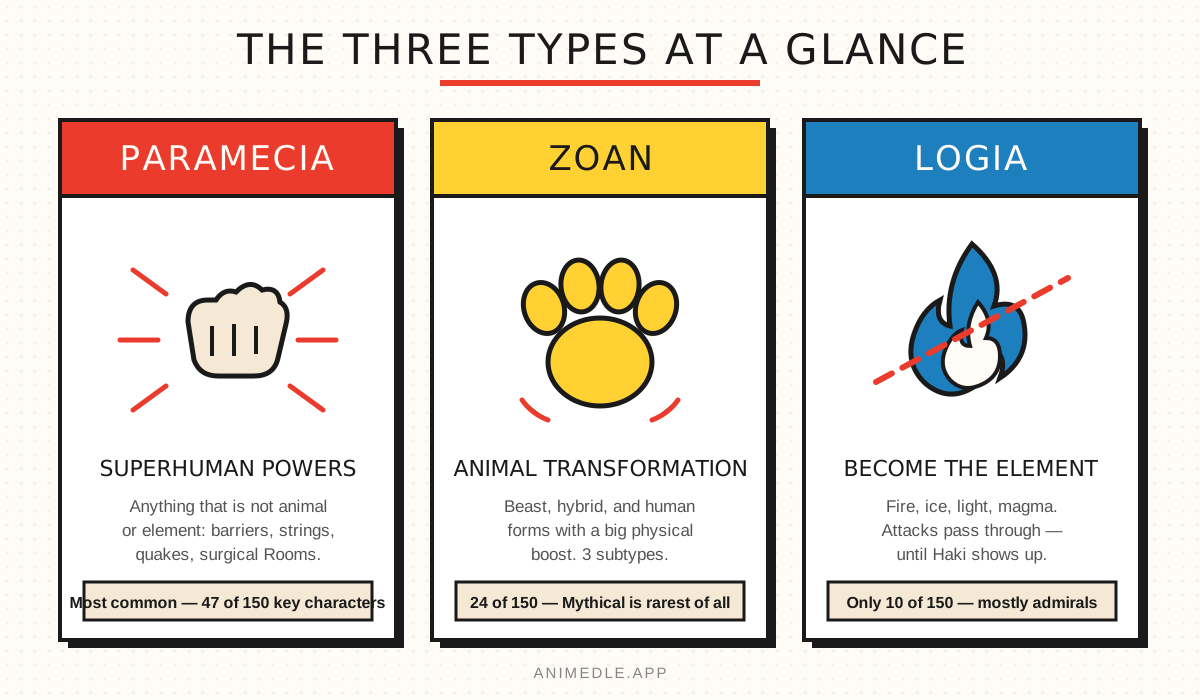
One panel each: what defines Paramecia, Zoan, and Logia.
The Data: Fruit Types Among One Piece's 150 Most Important Characters
Every Devil Fruit guide repeats the same qualitative claims — "Paramecia is most common, Logia is rarest." We can do better. The Animedle character database tags the 150 most story-relevant One Piece characters (every Straw Hat, Emperor, admiral, Warlord, and major arc player) with their exact fruit and type. Here is the actual distribution:
| Fruit type | Characters | Share of 150 |
|---|---|---|
| No Devil Fruit | 69 | 46.0% |
| Paramecia | 47 | 31.3% |
| Mythical Zoan | 11 | 7.3% |
| Logia | 10 | 6.7% |
| Ancient Zoan | 8 | 5.3% |
| Regular Zoan | 5 | 3.3% |
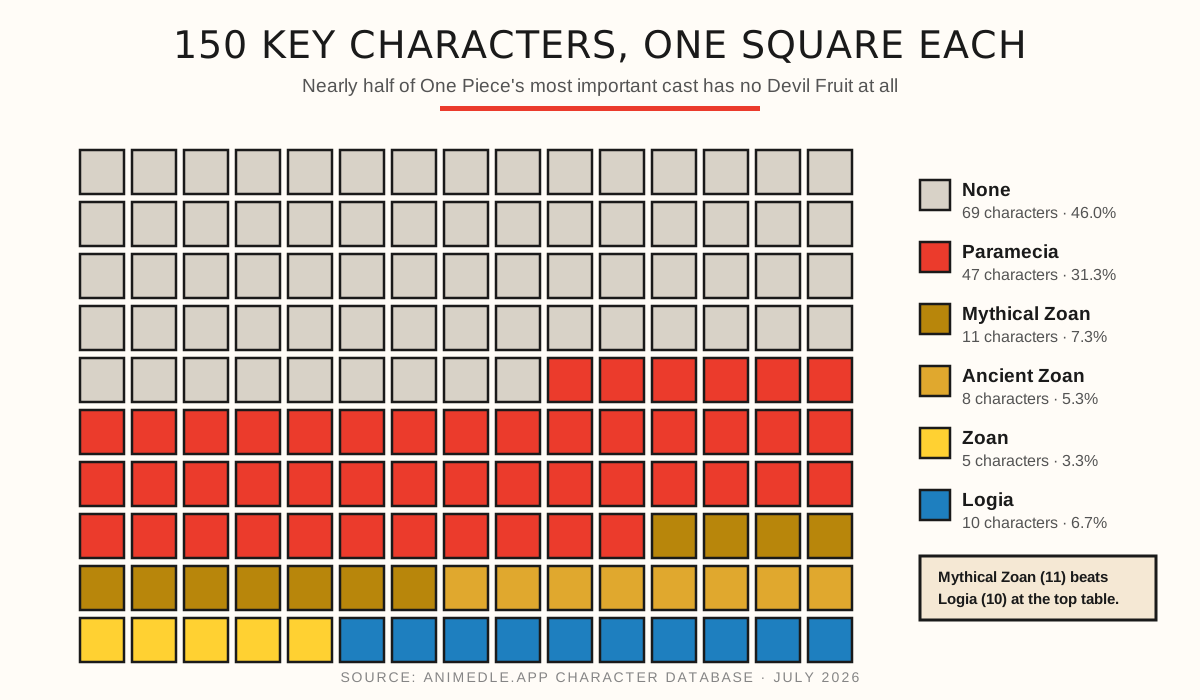
Each square is one of the 150 most important characters in One Piece.
Three findings stand out.
Finding 1: The most common "fruit type" in One Piece is no fruit at all. 69 of the 150 most important characters — 46% — have never eaten a Devil Fruit. That list is not filler, either: it includes Zoro, Sanji, Shanks, Mihawk, Rayleigh, Garp, and most of the samurai of Wano. Oda has been remarkably consistent about keeping roughly half of his top cast fruit-free, which quietly reinforces one of the series' core themes: Haki and skill beat borrowed power.
Finding 2: Mythical Zoans outnumber Logias at the top of the story. The "rarest fruit type" — Mythical Zoan — has 11 representatives among the 150, edging out Logia's 10. Rarity in-world clearly does not mean rarity on-page. The explanation is structural: the final saga's heavyweights (Luffy, Kaido, Yamato, Sengoku, the Gorosei) are disproportionately Mythical Zoan users, because Oda saves the legendary creatures for legendary characters. Logia, by contrast, peaked as the villain type of the first half — Crocodile, Enel, Ace's era — and has barely gained a new user since.
Finding 3: Zoans as a family are more common than Logia — but scattered. Combined, the three Zoan subtypes account for 24 characters (16%), more than double Logia's 10. But they cluster hard by faction: the Beasts Pirates hold most Ancient Zoans, CP9 holds most regular Zoans, and Mythical Zoans concentrate among Emperors, Marines' top brass, and the World Government's inner circle. Faction predicts fruit type surprisingly well.
A note on method: counts are from the Animedle database of 150 curated characters as of July 2026, using each character's most recently revealed canonical fruit classification (Luffy counts as Mythical Zoan, not Paramecia). The 150 were selected for story importance, so this measures the distribution among major characters, not among all fruits in the world.
Why This Matters for the Devil Fruit Guessing Game
Animedle's Devil Fruit mode asks you to identify a mystery character from fruit-related clues, and the distribution above is effectively the game's answer key — in probability form.
- "Does the character have a fruit?" is the single most valuable early question. With the pool split 46/54, fruit presence cuts the candidate list nearly in half no matter which way the answer falls. It is the closest thing the mode has to a perfect opening filter.
- A "Paramecia" clue is weak; a subtype clue is strong. Learning the answer is a Paramecia still leaves 47 candidates — almost a third of the pool. Learning it is a regular Zoan leaves five. Learning it is Logia leaves ten, and most of those are admirals or early-saga villains, which pairs beautifully with an arc clue.
- Mythical Zoan means late-game royalty. All 11 Mythical Zoan users are Emperors, top Marines, Gorosei, or their immediate circle. If the fruit clue says "Mythical Zoan," you should already be guessing at the very top of the power ladder.
- Faction and fruit type correlate. Beasts Pirates → think Ancient Zoan. CP9 → regular Zoan. Marine admiral → Logia. These shortcuts routinely save two or three guesses.
The same logic transfers to the classic OnePieceDle grid, where Devil Fruit type is one of the eight comparison columns. For the full numbers on which columns carry the most information, see our companion data study on the statistically best first guesses.
What Is Awakening?
Awakening is the advanced state of a Devil Fruit, reached when an exceptional user pushes their power beyond its normal limits — and it works differently for each type. Awakened Paramecias extend the user's power to their surroundings: Doflamingo converting buildings into string, Law reducing his own lifespan to perform impossible surgeries, Luffy's Gear 5 bending the world itself like rubber. Awakened Zoans gain monstrous strength and recovery, but at a documented cost — the Impel Down Jailer Beasts show that an unprepared user can lose their human mind to the beast. Awakened Logias remain the least shown on-page; the strong implication is environment-scale transmutation of their element, but Oda has kept the type's awakening deliberately mysterious.
Awakening is also the best evidence for the "types are a taxonomy, not a tier list" argument: the awakening of a mid-tier Paramecia (string) proved more strategically dangerous than most un-awakened Logias ever did.
FAQ
What are the 3 types of Devil Fruit in One Piece?
The three Devil Fruit types are Paramecia (superhuman abilities, like Robin's limb-sprouting Hana Hana no Mi), Zoan (animal transformation, like Chopper's Hito Hito no Mi), and Logia (elemental embodiment, like Ace's fire). Zoan further splits into regular, Ancient, and Mythical subtypes. Among the 150 most important characters, Paramecia is the most common type with 47 users.
Which Devil Fruit type is the rarest?
By in-world lore, Mythical Zoan is the rarest classification of any Devil Fruit — rarer even than Logia. Ironically, our data on One Piece's 150 most important characters counts 11 Mythical Zoan users versus 10 Logias, because late-saga heavyweights like Luffy, Kaido, Sengoku, and Yamato all carry mythical fruits.
Is Luffy's fruit a Paramecia or a Zoan?
Luffy's fruit is a Mythical Zoan. For most of the series it was believed to be the Gomu Gomu no Mi, a rubber-body Paramecia, but the Wano arc revealed its true name: the Hito Hito no Mi, Model: Nika, which grants the properties of the legendary "Sun God" Nika. Its awakened form is Gear 5.
Are Logia fruits the strongest type?
Not reliably, and less so as the series progresses. Logia intangibility was dominant early on — Crocodile and Enel each nearly ended Luffy — but Haki, standard among New World fighters, lets attackers hit a Logia's real body. Meanwhile the strongest fruits shown on-page include Paramecias (Whitebeard's quake) and Mythical Zoans (Nika, Kaido's dragon).
How many One Piece characters have no Devil Fruit?
Among the 150 most story-important characters in the Animedle database, 69 characters — 46% — have no Devil Fruit at all. The fruitless list includes top-tier fighters like Zoro, Sanji, Shanks, Dracule Mihawk, Silvers Rayleigh, and Monkey D. Garp, all of whom rely on Haki and swordsmanship or martial arts.
Can a Devil Fruit user learn to swim?
No. Losing the ability to swim is the universal, permanent price of any Devil Fruit — regardless of type or strength. Standing water and Seastone both drain a user's strength. This is why every fruit user at sea, from Luffy to the admirals, depends on crewmates if they go overboard.
Written by the Animedle team — we maintain the 150-character One Piece database that powers our six daily guessing games, and we spend an unhealthy amount of time fact-checking fruit classifications. Last updated July 2026.
Think you know your fruits now? Prove it in the daily Devil Fruit mode, or browse every user and their exact fruit in the character encyclopedia.
Put it into practice
A new mystery One Piece character drops every day at 00:00 UTC — six modes, free, no sign-up.
Play today's OnePieceDle