Quick answer: To win OnePieceDle consistently, open with a character whose attributes cover the biggest slices of the pool (a Marine or a Straw Hat works well), use your second guess to create maximum contrast with the first, read yellow affiliation cells as overlap signals rather than misses, and bracket bounty and height with the ↑/↓ arrows instead of guessing names you merely like. Players who follow a structured opening typically solve the daily puzzle in 4–6 guesses.
Most players lose OnePieceDle the same way: they type their favorite character first, stare at a wall of red, and then guess emotionally for the rest of the round. That is not a strategy — it is a coin flip with extra steps.
This guide is different. Every tip below is grounded in the actual numbers behind Animedle's OnePieceDle, which draws its daily answer from a curated pool of 150 major One Piece characters. We measured how much information each attribute column really gives you, which openings eliminate the most candidates, and where players throw guesses away. If you want the full statistical breakdown, our companion piece — the best first guess, according to data — goes deeper. Here, we focus on what to do.
What you'll learn:
- What each color and arrow in the grid actually means (and the misreads that cost you guesses)
- Four opening guesses that slice the 150-character pool most efficiently
- How to convert yellow cells into eliminations during the midgame
- Endgame bracketing techniques for bounty and height
- The five most common mistakes — and a practice plan to fix them
What the Colors Really Mean
Before strategy, fluency. OnePieceDle compares your guess to the hidden answer across eight attribute columns: Gender, Crew/Affiliation, Origin, Bounty, Height, First Arc, Devil Fruit Type, and Race. Each cell comes back in one of a few states, and misreading them is the number-one source of wasted guesses.
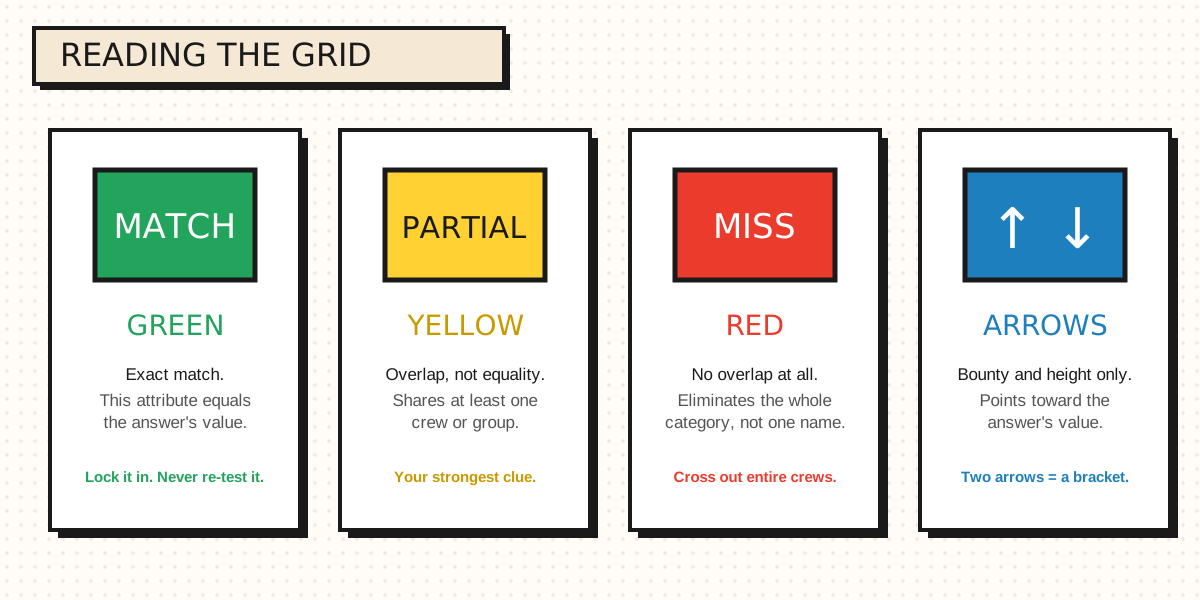 The four feedback states: exact match, partial match, no match, and directional hints.
| Feedback | What it actually means | Common misread |
|---|---|---|
| 🟩 Green | This attribute matches the answer exactly. | None — green is the easy one. |
| 🟨 Yellow | Partial match. For affiliation, your guess shares at least one crew or group with the answer, but not all of them. | Treating yellow as "wrong." Yellow is a clue, often the strongest one in the round. |
| 🟥 Red | No overlap at all on this attribute. | Forgetting that red eliminates an entire category, not just one character. |
| ↑ / ↓ Arrow | Numeric attributes only (bounty, height). The answer's value is higher (↑) or lower (↓) than your guess's. | Reading the arrow as describing your guess instead of pointing toward the answer. |
Two rules of thumb worth memorizing:
- Yellow affiliation is a treasure map. Characters in this game can belong to several groups at once — Monkey D. Luffy is simultaneously a Straw Hat Pirate, a member of the Worst Generation, and one of the Four Emperors. A yellow cell tells you exactly which shared group to hunt through.
- Arrows compound. One ↑ on bounty is vague. An ↑ from a 400 million guess and a ↓ from a 3 billion guess is a bracket — suddenly only a handful of characters fit.
Opening Tips (1–4)
What is an opening in OnePieceDle? The opening is your first two or three guesses, before you have enough colored cells to reason deductively. The goal is not to hit the answer — it is to split the pool. According to our analysis of the 150-character database, the affiliation column alone carries 5.10 bits of information, more than any other column, which is why every good opening is built around it.
Tip 1: Open With a Marine, Not Your Favorite
The Marines are the single largest affiliation in the pool — 14 of 150 characters — and Marine guesses test several rare states at once. Take Smoker: Male, Marines, East Blue origin, no bounty, 209 cm, Loguetown debut, Logia fruit, Human. That one guess probes the largest faction, the "no bounty" state (common among Marines and Revolutionaries), and the rarest fruit class (only 10 of 150 characters are Logia users, per our database).
Why it works: whether each cell comes back green, yellow, or red, you learn something that eliminates dozens of candidates. A red on "Marines" alone removes the biggest single block in the game.
Tip 2: Make Your Second Guess the Opposite of Your First
If guess one was a Marine officer, guess two should be a pirate — ideally from a big crew. The Big Mom Pirates (11 characters) and Straw Hat Pirates (10) are the largest pirate blocks in the pool. Charlotte Katakuri is a strong contrast pick: Big Mom Pirates, Grand Line origin, 1.057 billion bounty, 509 cm tall, Whole Cake Island debut, Paramecia user.
Why it works: contrast maximizes new information. If your first guess and second guess share attributes, the second guess re-tests things you already know. Katakuri against Smoker differs on every single column — eight fresh data points instead of four.
Tip 3: Use Romance Dawn as an Arc Anchor
First Arc is the second most informative column in the game (4.47 bits in our data), and debut arcs cluster hard: Whole Cake Island introduced 16 of the pool's characters, Wano Country 15, Dressrosa 13, and Romance Dawn 10. An early guess from Romance Dawn — Luffy, Zoro, Koby, or Shanks all debut there — tests the "East Blue era" hypothesis in one move. A red tells you the answer comes from the later, much larger half of the story; an arrowless green narrows you to ten names immediately.
Tip 4: Don't Burn Guesses on One-of-a-Kind Characters Early
Guessing Tony Tony Chopper first feels clever — until you realize that "Reindeer" race matches exactly one character in the entire game: Chopper himself. The race column is one of the weakest openers in the game precisely because 126 of 150 characters (84%) are Human. A red on "Reindeer" teaches you almost nothing you didn't already assume. Save the unique characters (Chopper, the Giants, the lone Longarm) for when the clues actually point at them.
Midgame Tips (5–9)
The midgame starts the moment you get your first yellow or green. From here, every guess should be a deduction, not a hope.
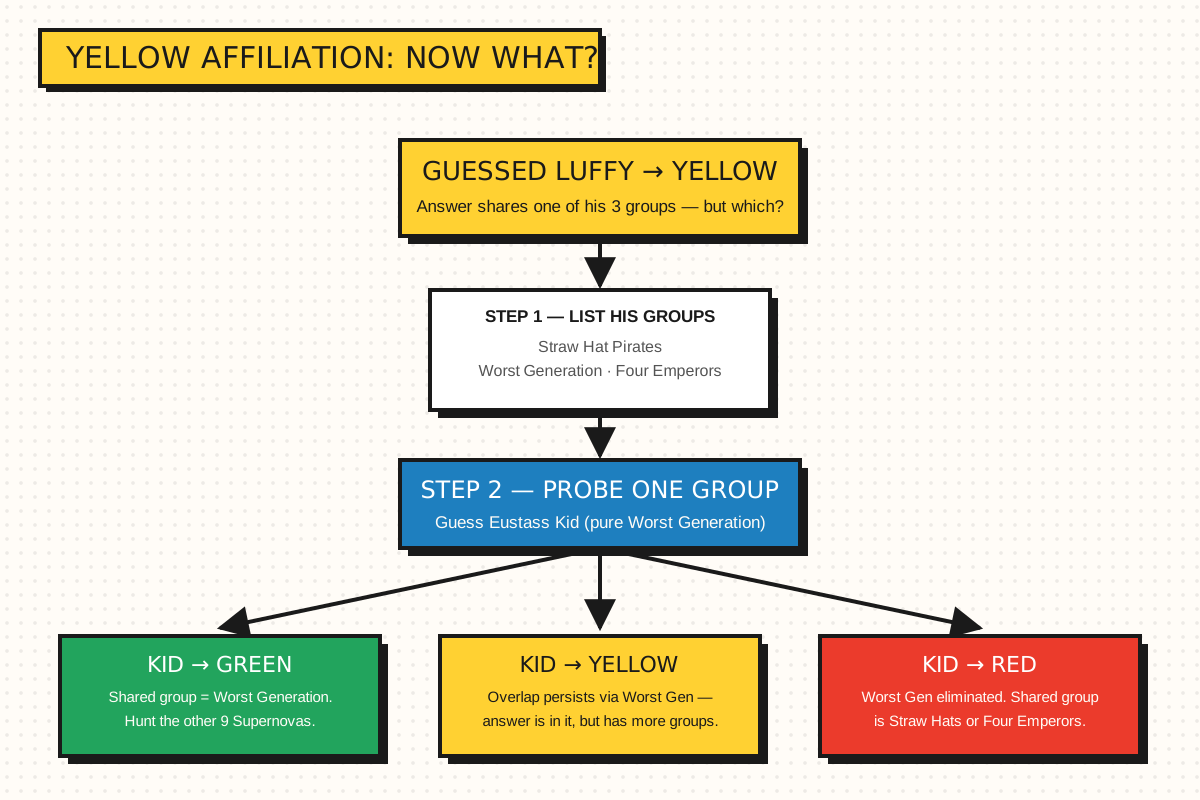 A yellow affiliation cell narrows your next guess to a shared-group hunt.
Tip 5: Decode Yellow Affiliation Like a Detective
Yellow on affiliation means your guess and the answer share at least one group. Suppose you guessed Luffy and got yellow: the answer shares "Straw Hat Pirates," "Worst Generation," or "Four Emperors" with him — but isn't Luffy. Trafalgar Law (Heart Pirates + Worst Generation) and Kaido (Beasts Pirates + Four Emperors + Rocks Pirates) are both live candidates; Nami (Straw Hat Pirates only) would have produced a different overlap. Your next guess should deliberately isolate which group is shared: guess a pure Worst Generation member like Eustass Kid, and the color tells you which branch to follow.
Tip 6: Treat Height as a Body-Type Filter
Newcomers assume most characters are human-sized. The data disagrees: the median height in the pool is 246 cm, and 49 of 150 characters stand 300 cm or taller. When the height arrow says ↑ from your 180 cm guess, don't creep upward in 10 cm steps — jump. Guessing Jinbe (301 cm) or Katakuri (509 cm) splits the "big body" population far faster than guessing another lean swordsman. The height column matches within a ±2 cm tolerance, so near-misses still register as arrows, not greens.
Tip 7: Use Arc Feedback to Time-Travel
Because debut arcs cluster (Whole Cake 16, Wano 15, Dressrosa 13, per our 150-character database), arc feedback lets you reason about when the answer entered the story. Red on "Marineford" plus red on "Romance Dawn" pushes you toward the post-timeskip arcs, which contain roughly half the pool. Combine that with a green on "Grand Line" origin (84 of 150 characters — 56% — originate there) and you're often down to a couple dozen names by guess four.
Tip 8: Remember That "None" Is the Most Common Devil Fruit
It's easy to fixate on flashy powers, but 69 of the 150 characters — 46% — have no Devil Fruit at all. Zoro, Nami, Shanks, Mihawk, and Jinbe are all fruitless. If your Devil Fruit column keeps coming back red on Paramecia and Logia guesses, the smart play is a strong "None" candidate rather than a third fruit type. Conversely, a green on "Mythical Zoan" is gold: only 11 characters in the pool have one.
Tip 9: Read a Blank Bounty as a Faction Hint
A "no bounty" state is not missing data — it is a clue. In our database, 84 of 150 characters have no listed bounty, and they skew heavily toward Marines, Cipher Pol agents, and civilians. Smoker, Sakazuki, and Koby all carry null bounties. If the bounty cell shows "Unknown" matching, you should immediately weight law-enforcement and non-pirate candidates in your remaining guesses.
Endgame Tips (10–12)
By guess five or six you should hold several greens, a bracket or two, and a mental shortlist. The endgame is about converting that shortlist into the answer without leaking guesses.
Tip 10: Bracket Bounty Like a Binary Search
Known bounties in the pool run from small-time numbers up to Gol D. Roger's 5.5648 billion, with a median of 400 million and only 22 characters at or above 1 billion. Use that shape. If an ↑ arrow appears on your 366 million guess (Nami), jump to the billion tier — Zoro at 1.111 billion or Hancock at 1.659 billion — rather than inching to 500 million. Two well-placed guesses bracket almost any bounty into a range holding two or three characters.
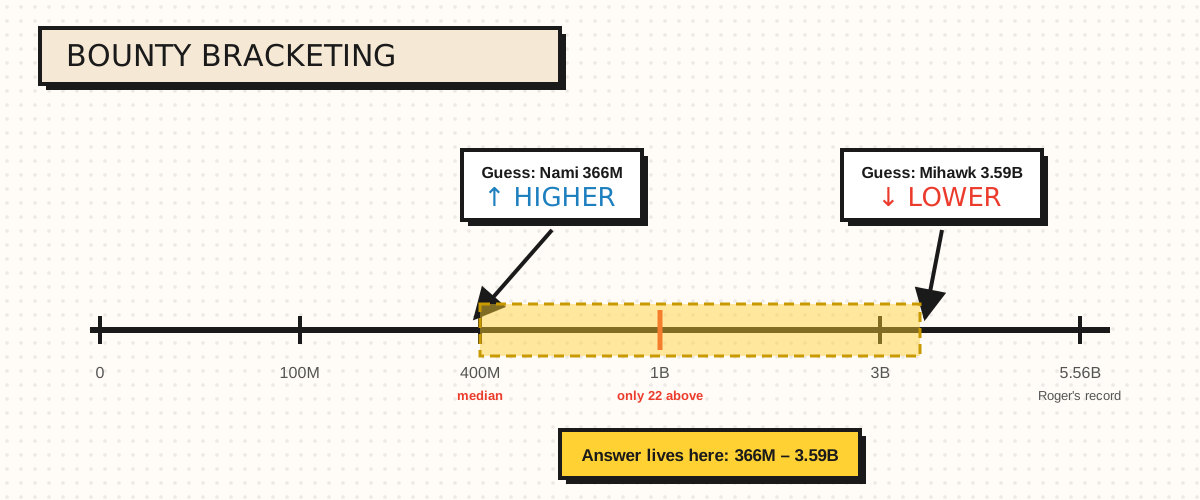 Bracketing: one ↑ and one ↓ collapse the bounty range dramatically.
Fun trap to know: Luffy, Law, and Eustass Kid all sit at exactly 3 billion berries. A green bounty cell at 3,000,000,000 does not uniquely identify the answer — check the other columns before you celebrate.
Tip 11: Spend Your Free Clues Before Your Guesses
OnePieceDle hands you 3 free starting clues, and every 2 incorrect guesses it unlocks another — height range first, then bounty tier, Devil Fruit presence, origin region, and era — while the silhouette sharpens one blur step at a time (from 20px down to 0 across five levels). Before each endgame guess, re-read the unlocked clue list against your shortlist. Players routinely ignore a "Bounty: over 100 million" clue that would have eliminated half their remaining candidates. The clues are free information; the guesses are not — burn the cheap resource first.
Tip 12: When Two Candidates Remain, Guess the One That Teaches More
Suppose your shortlist is down to Portgas D. Ace and Sabo — both Logia users of the very same Mera Mera no Mi, both with bounties in the 550–602 million band. They still differ on affiliation (Whitebeard Pirates vs. Revolutionary Army), origin (South Blue vs. East Blue), and debut arc (Alabasta vs. Dressrosa). If you're wrong about Ace, the affiliation and arc cells will confirm Sabo beyond doubt — so there is no third guess. Always pick the candidate whose failure fully resolves the puzzle.
Common Mistakes That Cost You Streaks
- Guessing emotionally after a near-miss. A yellow affiliation triggers "it must be his captain!" thinking. Slow down; list the shared groups first.
- Re-testing known information. If East Blue already came back red, guessing three more East Blue characters wastes turns. Every guess should test at least two unknown attributes.
- Ignoring the silhouette. By guess six, the blur is down to 8px or less. Distinctive outlines — Brook's afro, Franky's forearms — often settle the endgame instantly.
- Forgetting the pool has boundaries. The daily answer comes from 150 major characters, not the entire 1,000+ character canon. Extremely obscure names aren't in play; stop guessing them.
- Abandoning structure when frustrated. The moment you start typing names "to see what happens," your expected guess count roughly doubles. Trust the bracket.
A Practice Plan That Actually Works
You don't build these reflexes on one puzzle a day. Unlimited mode serves a fresh random character every round with the same rules and no streak at stake — it is the practice room.
- Rounds 1–3: openings only. Play three unlimited rounds using Tips 1–2. Don't chase the win; watch how much of the board each opening resolves.
- Rounds 4–6: yellow drills. Every time a yellow appears, write down (yes, physically) every group your guess belongs to before choosing the next name.
- Rounds 7–9: bracket practice. Force yourself to solve bounty and height with two arrows or fewer per column.
- Round 10: full game, count your guesses. Most players who complete this ladder drop from 8+ guesses to 4–6 within a week.
While you practice, keep the character index open in another tab. Browsing crews and factions builds exactly the mental map — who belongs to what, who debuted where — that the affiliation and arc columns reward.
FAQ
How many guesses do you get in OnePieceDle?
OnePieceDle allows unlimited guesses on both the daily and unlimited modes, so you can never "lose" by running out. Your streak and stats, however, record how many guesses you needed — structured players typically finish the daily puzzle in 4–6 guesses, while random guessing often takes 10 or more.
What is the best first guess in OnePieceDle?
Statistically, a character who tests the biggest attribute blocks: a Marine like Smoker probes the largest faction (14 of 150 characters), the no-bounty state, and the rare Logia class in a single guess. Our full analysis of all 150 characters ranks the top five openers — read the data study.
What does yellow mean in OnePieceDle?
Yellow marks a partial match. On the affiliation column it means your guess shares at least one crew or group with the answer — for example, guessing Luffy when the answer is Trafalgar Law yields yellow because both belong to the Worst Generation. Yellow never means "wrong"; it identifies the exact overlap to investigate next.
How often do clues unlock?
You start every round with 3 free clues, and one additional clue unlocks after every 2 incorrect guesses, in a fixed order: height range, bounty tier, Devil Fruit presence, origin region, then era. The character silhouette also sharpens by one blur level at the same rate, from 20px blur to fully clear over five steps.
Is height or bounty more useful for narrowing guesses?
Bounty usually narrows harder at the top end — only 22 of 150 characters have bounties of 1 billion berries or more — but 84 characters have no bounty at all, which blunts the column. Height is known for all 150 characters (median 246 cm), making it the more reliable bracketing tool, especially for separating human-scale characters from the 49 who stand 300 cm or taller.
Written by the Animedle team — the people who curated the 150-character attribute database this game (and this article's every statistic) runs on. Last updated July 13, 2026. Found an attribute error? Email support@animedle.app.
Ready to put the system to work? Play today's OnePieceDle — or warm up with a few rounds in unlimited mode first.
Put it into practice
A new mystery One Piece character drops every day at 00:00 UTC — six modes, free, no sign-up.
Play today's OnePieceDle